The Cambodian people are some of the kindest and friendliest people I have encountered in my travels around the world. However, as most of us know Cambodia has had a very sad and violent history. I don't think any family in Cambodia today has not been touched by the horrific four-year rule of the Khmer Rouge in the '70s.
The communist Khmer Rouge party headed by Pol Pot took over Phnom Penh in April of 1975 and ruled the country until Viet Nam invaded in early January 1979. However, the Khmer Rouge then took to the jungle and for nearly two decades waged a civil war with the government. Not only was the infrastructure of the country demolished but landmines were planted all over the country and despite years of clearing mines there are still many in place today in remote areas.
The human death toll from April 1975 to January 1979 is what I am going to talk about.
When the Khmer Rouge "came to town" in Phnom Penh on April 19th, 1975 they told people to leave their homes as the Americans were going to bomb the city (highly feasible as the Americans had bombed the southern part of the country in the early 70's - today many Cambodians still dislike and distrust the American government) - they were told they would be able to come back in three days. Well needless to say....hard to believe now but for four years what is now a bustling busy city was virtually a ghost town.
The Khmer Rouge headed by Pol Pot believed in an agrarian-based communist society - a society of sufficiency on agriculture. Cambodia became known as Democratic Kampuchea. City people were required to move to the country and become farmers. Forced to work long hard hours with little or no food, many starved to death or were beaten, sometimes to death for stealing food to feed themselves and their families. Oh yes, even the children were forced to work - many many children died slow deaths of disease and starvation. Or were killed simply because they dared to eat some of the rice they were harvesting. Everyone was given dark regulation clothing to wear.
Of course, if you are going to do this you want to eliminate anyone who could possibly cause a revolution - thus anyone with a university education, any employee of the former government, anyone with their own business, heck anyone wearing glasses - because obviously, you must be literate if you wore glasses, artists, ..these people were imprisoned, many tortured and then executed. Their families were usually executed as well.
I encountered my first victim of this genocide in January 2013 on my flight from Singapore to Cambodia. I sat beside a fellow who introduced himself as John. John was a Cambodian who had lived in the United States since the '80s and was a successful retired businessman from Florida. He was going "home" for six weeks to visit family. We chatted about different things not related to this horrific part of their history. He then asked me if I was going to visit the Tuol Sleng prison museum which was known as S-21. (a former high school) When I replied in the affirmative he told me simply that his father was a high school teacher there. I sat there stunned - what do you say. I knew what was coming next... he continued on to say that his father was executed along with his mother and his six younger siblings as well as some extended family. He was spared however because he was in the 8 to 13 year old age group - they did spare some children in that group to become spies and child soldiers. He never elaborated on what happened from there but I can just imagine. How all this happened was never quite clear but he was given the opportunity to go to America in the '80s along with others and he never looked back - he has done well for himself. He has been back a few times but many friends of his have never gone back to Cambodia - there is nothing for them to go back for and they want to remember Cambodia the way it was before their lives changed forever. He has an uncle and a couple of cousins that survived and now have families so he goes for six weeks every couple of years. I think he helps them out financially from what I could gather.
Our guide Thyda's family lived in the country so they were lucky enough to survive. Her father was a medical assistant who quickly became a farmer during those four years and went back to being a medical assistant thereafter. She said it was very lucky for him that no one told the authorities what his profession truly was. Others were not as lucky.
On our first day of the tour of Cambodia we went to the Tuol Sleng prison musuem. As I mentioned this was a former high school that was turned into a notorious interrogation centre. Doctors, students, monks, factory workers, engineers and more were tortured and confessed to covert activities that most of them had never done They were then taken to Choeung Elk (the killing fields) and executed. Up to 1500 prisoners were kept here at the same time - I can't even imagine the cramped conditions let alone the cruelty that went on here.
For more detail information on this museum you can click here. Be warned: it's graphic.
Here are some pictures from my visit...if you are squeamish or don't like unpleasant things stop reading now however I think it is important for people to know what happened.
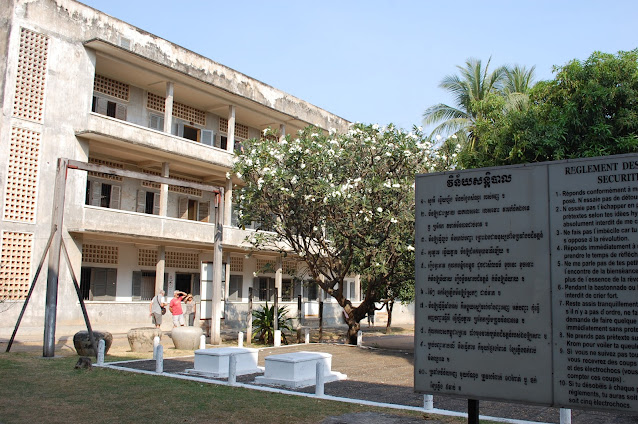


The female prisoners were known to be raped from time to time - barbed wire was put up to prevent the women from jumping from the building and committing suicide. Despite not being adverse to torturing people, rape was frowned upon and the perpetrators if found, were executed. I won't go into the forms of torture prisoners had to endure... What is even more upsetting is that the instigators of all of this have virtually gotten away with it..The trial in the '90s was more or less a joke and it wasn't until the UN got involved in 2008 that they were tried as war criminals that justice was even remotely done. Of course, by then they were either dead or very old and had lived most of their lives in freedom.
We then went on to Choeung Elk (the Killing fields) which was even more upsetting. This is where the executions took place. It is estimated that anywhere from 1.7 to 3 million were executed or died of disease/starvation during the years of the Khmer Rouge. People just "disappeared". These included religious or ethnic minorities as well as those I mentioned above.


Is it grisly? Of course. Is it strange to want to go to these places? Some think so. I don't. Visitors tell friends who tell friends - knowledge is power. I'd like to say we can never forget or try to erase the past - it is there for us to learn from.
It was a very emotional morning and we were a very quiet bunch in the van back to the hotel. I had read a lot about the Khmer Rouge before coming to Cambodia but seeing the place where the horrors took place was very overwhelming. I think the victims would want people to know about what they went through - not to have it "shoved under the carpet" to not be thought or spoken about.
The communist Khmer Rouge party headed by Pol Pot took over Phnom Penh in April of 1975 and ruled the country until Viet Nam invaded in early January 1979. However, the Khmer Rouge then took to the jungle and for nearly two decades waged a civil war with the government. Not only was the infrastructure of the country demolished but landmines were planted all over the country and despite years of clearing mines there are still many in place today in remote areas.
The human death toll from April 1975 to January 1979 is what I am going to talk about.
When the Khmer Rouge "came to town" in Phnom Penh on April 19th, 1975 they told people to leave their homes as the Americans were going to bomb the city (highly feasible as the Americans had bombed the southern part of the country in the early 70's - today many Cambodians still dislike and distrust the American government) - they were told they would be able to come back in three days. Well needless to say....hard to believe now but for four years what is now a bustling busy city was virtually a ghost town.
The Khmer Rouge headed by Pol Pot believed in an agrarian-based communist society - a society of sufficiency on agriculture. Cambodia became known as Democratic Kampuchea. City people were required to move to the country and become farmers. Forced to work long hard hours with little or no food, many starved to death or were beaten, sometimes to death for stealing food to feed themselves and their families. Oh yes, even the children were forced to work - many many children died slow deaths of disease and starvation. Or were killed simply because they dared to eat some of the rice they were harvesting. Everyone was given dark regulation clothing to wear.
Of course, if you are going to do this you want to eliminate anyone who could possibly cause a revolution - thus anyone with a university education, any employee of the former government, anyone with their own business, heck anyone wearing glasses - because obviously, you must be literate if you wore glasses, artists, ..these people were imprisoned, many tortured and then executed. Their families were usually executed as well.
I encountered my first victim of this genocide in January 2013 on my flight from Singapore to Cambodia. I sat beside a fellow who introduced himself as John. John was a Cambodian who had lived in the United States since the '80s and was a successful retired businessman from Florida. He was going "home" for six weeks to visit family. We chatted about different things not related to this horrific part of their history. He then asked me if I was going to visit the Tuol Sleng prison museum which was known as S-21. (a former high school) When I replied in the affirmative he told me simply that his father was a high school teacher there. I sat there stunned - what do you say. I knew what was coming next... he continued on to say that his father was executed along with his mother and his six younger siblings as well as some extended family. He was spared however because he was in the 8 to 13 year old age group - they did spare some children in that group to become spies and child soldiers. He never elaborated on what happened from there but I can just imagine. How all this happened was never quite clear but he was given the opportunity to go to America in the '80s along with others and he never looked back - he has done well for himself. He has been back a few times but many friends of his have never gone back to Cambodia - there is nothing for them to go back for and they want to remember Cambodia the way it was before their lives changed forever. He has an uncle and a couple of cousins that survived and now have families so he goes for six weeks every couple of years. I think he helps them out financially from what I could gather.
Our guide Thyda's family lived in the country so they were lucky enough to survive. Her father was a medical assistant who quickly became a farmer during those four years and went back to being a medical assistant thereafter. She said it was very lucky for him that no one told the authorities what his profession truly was. Others were not as lucky.
On our first day of the tour of Cambodia we went to the Tuol Sleng prison musuem. As I mentioned this was a former high school that was turned into a notorious interrogation centre. Doctors, students, monks, factory workers, engineers and more were tortured and confessed to covert activities that most of them had never done They were then taken to Choeung Elk (the killing fields) and executed. Up to 1500 prisoners were kept here at the same time - I can't even imagine the cramped conditions let alone the cruelty that went on here.
For more detail information on this museum you can click here. Be warned: it's graphic.
Here are some pictures from my visit...if you are squeamish or don't like unpleasant things stop reading now however I think it is important for people to know what happened.
 |
| High ranking prisoners were shackled in these beds. |


 |
Typical cell.    |

 |
This is Chum Mey, a vehicle mechanic who survived. He was thought to be a CIA agent and tortured - his wife and children were executed. He was tortured repeatedly and confessed to being a CIA agent - a lie of course. What saved him? Chum Mey was able to fix a radio that was not working. He then worked as a mechanic for the Khmer Rouge. He was constantly in fear of his life. (as all those who worked for the Khmer Rouge) He has written a book and comes to the museum most days to sell it and talk to tourists - it is his only source of income. I bought his book. Very heart rendering. |
The female prisoners were known to be raped from time to time - barbed wire was put up to prevent the women from jumping from the building and committing suicide. Despite not being adverse to torturing people, rape was frowned upon and the perpetrators if found, were executed. I won't go into the forms of torture prisoners had to endure... What is even more upsetting is that the instigators of all of this have virtually gotten away with it..The trial in the '90s was more or less a joke and it wasn't until the UN got involved in 2008 that they were tried as war criminals that justice was even remotely done. Of course, by then they were either dead or very old and had lived most of their lives in freedom.
We then went on to Choeung Elk (the Killing fields) which was even more upsetting. This is where the executions took place. It is estimated that anywhere from 1.7 to 3 million were executed or died of disease/starvation during the years of the Khmer Rouge. People just "disappeared". These included religious or ethnic minorities as well as those I mentioned above.

 |
A tribute to the children killed. |
 |
Bones keep surfacing so they have closed this area off. |
 |
Mothers were forced to watch while their babies were beaten to death against the tree. |

 |
Pagoda with skulls of victims in...it sounds grotesque but it wasn't. It was very respectful. |

Is it grisly? Of course. Is it strange to want to go to these places? Some think so. I don't. Visitors tell friends who tell friends - knowledge is power. I'd like to say we can never forget or try to erase the past - it is there for us to learn from.
The sad part is genocide like this is still taking place all over the world.
It was very difficult to visit both of these places but as a visitor to Cambodia I believe it is very important to experience this in order to understand the country and its people.
Comments